
Industry
Part of Late-year birthdays: a reference you can cite as of 2027
How to make sense of musicians with late-year birthdays (2027 update)
Musicians born in November or December sit at the end of the calendar, and their birth dates need a second source like a birth certificate before you publish them.
Late-year birthdays are hard to verify for a plain reason: December is the month most likely to be rounded, misremembered or quietly adjusted in a publicity file. A date recorded as "December 1942" gets typed as a day by the next person who needs one.
What to take away
- A birth date is an identifier, not a decoration. Two musicians can share a name and a month, and only the day separates them.
- Ask which authority holds the record before you ask what the date is. Vital records offices, state departments of health and provincial registries each answer a different question.
- Time zone shifts a date by one day when a birth is recorded near midnight, so note the local clock the source used.
- Never publish a single date where two sources disagree. State both and name each source.
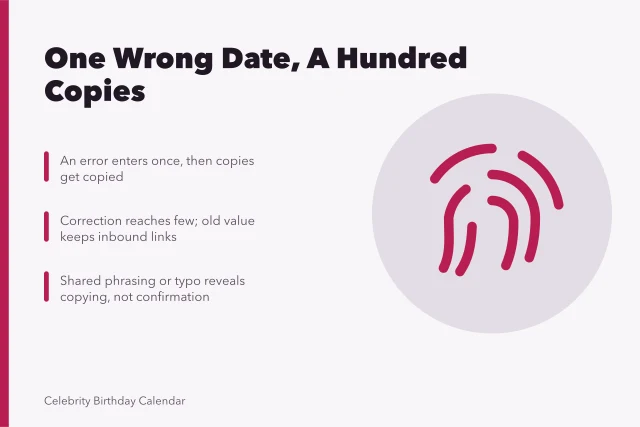
- A wrong date copied into a hundred pages costs more to fix than it cost to check once.
Why December dates go wrong first
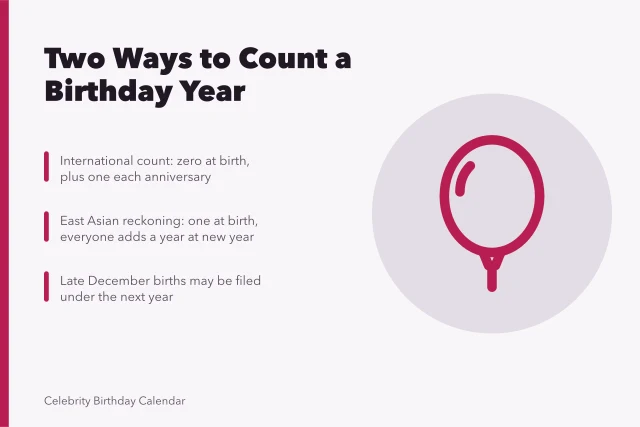
December carries the year boundary. A birth on 31 December sits one day from a new year, and a source that records only the year will place it on either side depending on who typed it. The same happens at the other end of the year.
Cross-check the day of the week. A date that falls on a Tuesday in one year cannot fall on a Tuesday in the next, and the drift is easy to compute. If a source gives a weekday and a date that disagree, one of them is wrong.
Where the record actually lives
Different authorities hold different facts, and none of them holds all of them.
| Authority | What it holds | What it will not tell you |
|---|---|---|
| State vital records office | Birth certificates, with stated eligibility rules | Anything outside its own state |
| State department of health | Statewide indexes and certificate copies | Records sealed by statute |
| Social Security death file | Death dates for a limited set of records | Living people, and no birth date at all |
| Provincial registry | Canadian provincial birth records | Records the province restricts |
| League media guide | Roster dates as the league published them | The underlying document |
| Studio publicity file | The date a studio chose to release | Whether anyone checked it |
A media guide and a birth certificate are not the same kind of source. The guide is a published claim, and the certificate is a record. Cite the one you actually used.
The clock problem
A birth at 11:50 p.m. local time on 30 November is 2 December in a time zone three hours east. Both dates are defensible and neither is wrong. The fix is to say which clock the source used.
This matters most for musicians born outside the United States, where a registry may record local time and a later biography may convert it without saying so. Keep the original and note the conversion.
Worked example
A page needs a date for a session musician credited on a 1968 record. Two sources disagree.
- A studio publicity file gives 3 December 1941.
- A provincial registry index gives 2 December 1941.
Do not pick one. Publish the disagreement, name both sources, and note that the two dates differ by one day and may reflect a time zone conversion. If the page cannot carry a hedge, it should not carry the date.
Copyright and publicity limits
A birth date is a fact and facts are not copyrightable in the United States. The compilation around them can be, and the right of publicity is a separate question governed by state law. Some states recognise a post-mortem right and some do not. Ask a licensed attorney before republishing a date you took from someone else's database.
Records access runs on eligibility rules set by the issuing office. If a record is sealed or restricted, the office will say who may request it. That is the only route, and it is not one this page can shortcut.
What to do with a disputed date
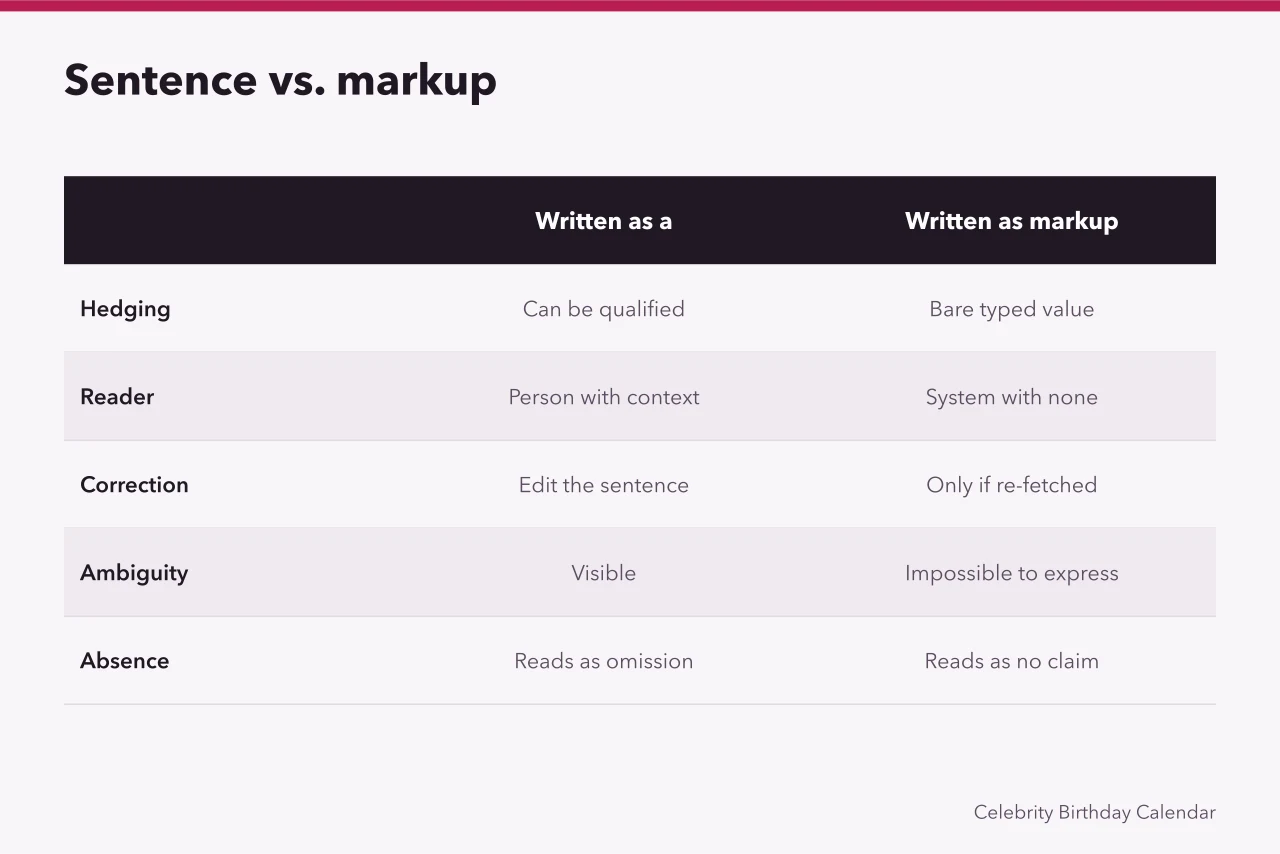
Hold the date out of any structured markup until it resolves. A typed value cannot carry a hedge, and once a consumer collects it, editing your page does not withdraw it from theirs. The late-year index explains why the grouping exists at all.
The February index sets out the same inclusion rule for a shorter month. The January index applies it to the year's first days, and the April birthdays page shows how the rule reads when the month is not crowded.
Common questions
Why do late-year birthdays need more checking than others?
December and January sit on the year boundary, so a source that records only a year can place the birth on either side. The month is also the one most often approximated in older publicity material.
What if two sources give different days?
Publish both, name each source, and say what the difference might be. A one-day gap often traces to a time zone conversion. Never resolve it by choosing the source you prefer.
Can I mark up a birth date once I have verified it?
You can, and the markup will be stronger than any sentence you write. A typed value carries no hedge and no source, so it should only hold what you would state without qualification. Schema.org defines the property, usually embedded as JSON-LD, and its existence is not an instruction to use it.
Where do I check a date I cannot verify myself?
The issuing state or provincial vital records office, which publishes its own eligibility rules. For a death date, the Social Security death file covers a limited set of records. For anything else, a licensed attorney can tell you what your state permits.
: the 2027 view](/covers/famous-late-year-birthdays-640.webp?v=3c42b113)