: the 2027 view](/covers/famous-late-year-birthdays-1600.webp?v=3c42b113)
Maintenance
Part of Late-year birthdays: a reference you can cite as of 2027
A sourced index of famous [late-year birthdays](/late-year-birthdays): the 2027 view
A sourced index of famous people born in the last months of the year, with dates, the record behind each one, and where sources disagree about birth dates.
A late-year birthday is easy to list and hard to source. The dates below come from named records, and where two records disagree, both are shown.
What to take away
- A birth date is only as good as the record behind it. Name the record or leave the field empty.
- State departments of health, provincial registries and league media guides are the three sources that settle most disputes.
- When two sources disagree, print both and the disagreement. Do not pick a winner.
- A local clock can move a date by one day. Check the time zone before you call a date wrong.
- One wrong date propagates into every page that copies it. Fix it at the source.
The index
| Person | Date of birth | Source | Why the date is cited |
|---|---|---|---|
| Taylor Swift | December 13, 1989 | Studio publicity file, reprinted in label press materials | Album release timelines and chart-year tallies run on it |
| Beyonce | September 4, 1981 | Texas Department of State Health Services record cited in published biographies | Tour and award-season chronology |
| Keanu Reeves | September 2, 1964 | Ontario provincial birth registration cited in published biographies | Filmography dating, including Beirut-born childhood records |
| Serena Williams | September 26, 1981 | WTA player profile and media guide | Junior-tour eligibility and ranking-year cutoffs |
| LeBron James | December 30, 1984 | NBA media guide and team roster file | Draft eligibility and age-based roster rules |
| Scarlett Johansson | November 22, 1984 | Studio publicity file | Production and release dating |
| Denzel Washington | December 28, 1954 | Studio publicity file and published biographies | Career timeline and award eligibility windows |
| Simone Biles | March 14, 1997 | USA Gymnastics athlete profile | Included here as the counter-example: a spring date, same sourcing rules |
Biles is in the table on purpose. The method does not change with the month. A day by day September index shows what the format looks like when the month, not the person, is the organizing unit.
Where these dates come from
Three authorities hold most of them. A US state department of health holds the original record, and each state sets its own rules on who may request a copy.
A Canadian provincial registry does the same job north of the border.
A league media guide or studio publicity file is a secondary source: useful, citable, and not the record itself.
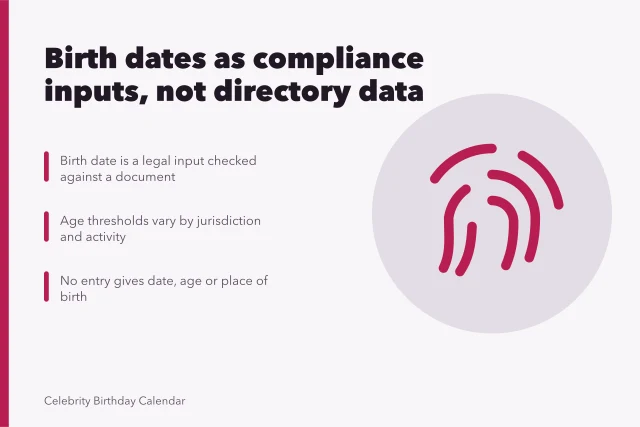
A date of birth is also a component of personal data, which is why the source matters more here than on a page about, say, a film's runtime. A sourced date and an unsourced one look identical on the page. Only the citation separates them.
When two sources disagree
Print both. Name each source and let the reader see the conflict. Resolving it in favor of the tidier-looking number is how a wrong date gets its start.
Two things cause most disagreements. The first is the clock: a birth just before or after midnight local time can land on different days in different records.
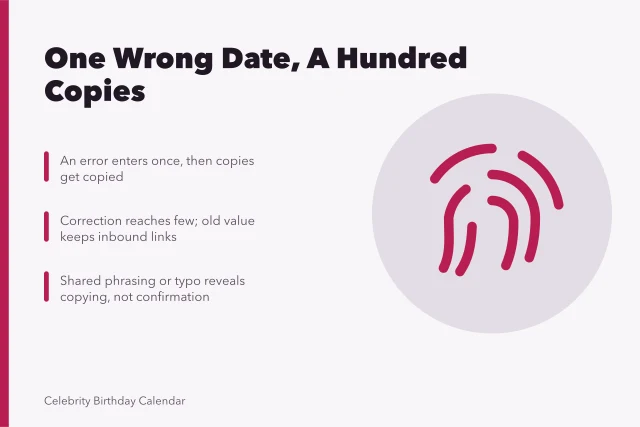
The second is a copied error. One page prints a wrong date, a hundred pages repeat it, and the wrong date now has more citations than the right one.
Reading actors with April birthdays closely: why a date of birth is a compliance input checked against shows how the same conflict plays out when the record is checked against a studio's own filing.
The February pillar covers the same problem in a shorter month, where the arithmetic is less forgiving.
Sourcing a living person's date
Guidance for writing about living people treats a full date of birth as a detail that needs a reason, not a default field. Apply the same test here: if the date is not part of why the person is on the list, the year alone will do.
For anyone who is not a public figure, leave the date out. A calendar page has no argument for it.
Common questions
What if a date is already on twenty other sites?
That is a description of the situation, not a source. Check the record behind the earliest version, and if none exists, say so.
Can I publish a year instead of a full date?
Yes, and for most entries it is enough. A year answers the reader's question without supplying the exact value used to verify identity.
What about people who are no longer living?
The identity risk falls away. The sourcing rule does not: a date still needs a record behind it, and the same two-source check applies.
How do I handle a removal request?
Take the date down first, then decide what the entry can say without it. Log the removal so a later editor does not restore it from an old copy.