Costs
Part of Late-year birthdays: a reference you can cite as of 2027
Actors with late-year birthdays: why one wrong date becomes a hundred copies
Actors with late-year birthdays: how one error becomes many copies, why a correction travels slower, and how to test whether two sources are independent.
Getting a date wrong is easy and forgivable. What is genuinely hard is getting it un-wrong. An error published once behaves very differently from a correction published once, and the asymmetry is the reason so many wrong dates are still in circulation years after somebody found the right one.
What to take away
- Agreement between sources is only evidence when the sources are independent, and most are not.
- A correction has to reach every copy. An error only had to be made once.
- If you cannot say where a date came from, you cannot tell whether five sources are five sources or one.
One error, many copies
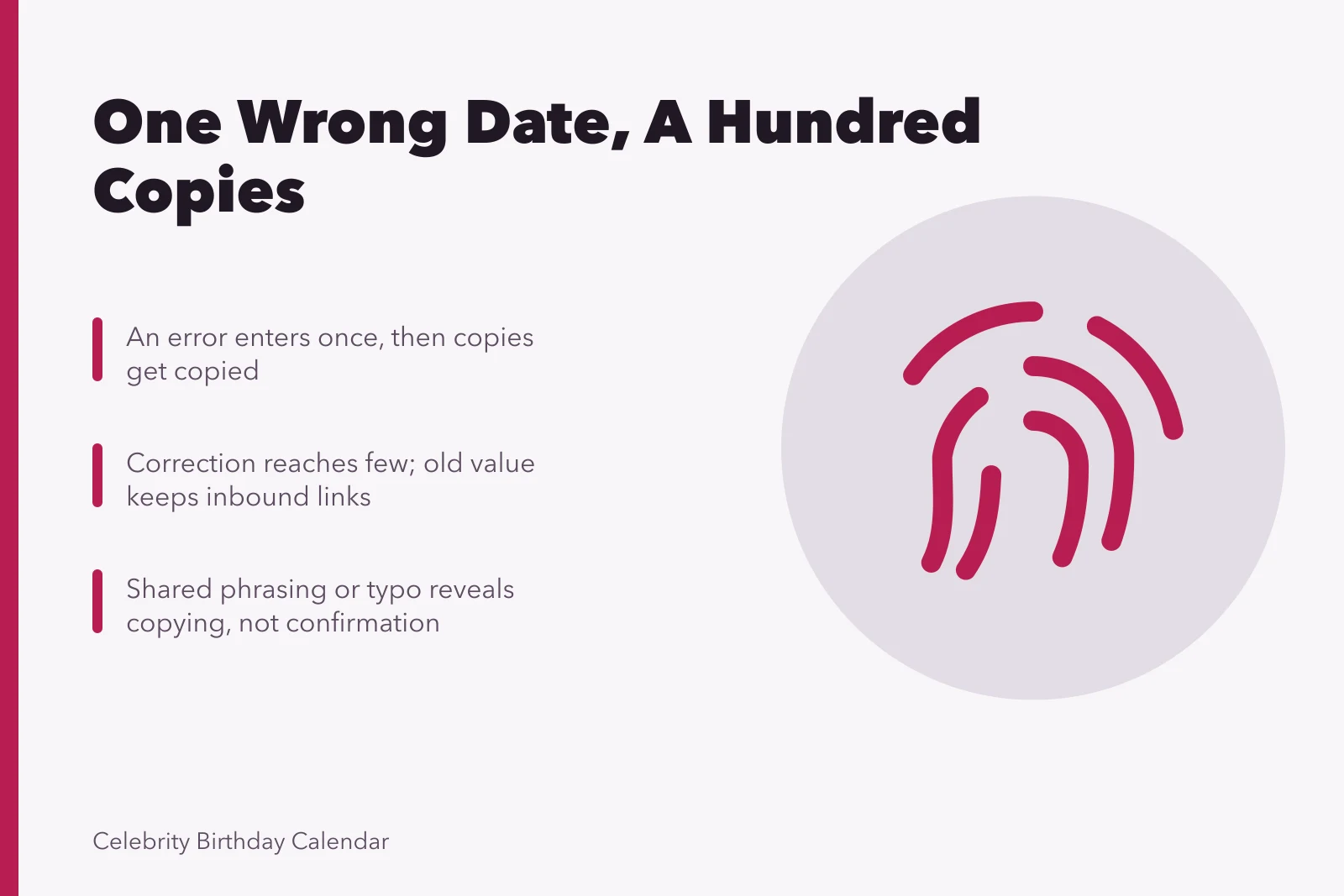
An error enters somewhere ordinary: a misread digit, a bio filled in at speed, a guess in a database field that did not allow a blank. Then it gets copied, and the copies get copied. Within a few cycles the value appears on many sites, in several languages, and in material that cites other material rather than any record.
At that point the wrong date has something the right one does not: apparent corroboration. This is circular reporting, and it is the main reason careful people repeat wrong values in good faith. They checked. They found agreement. The agreement was one source wearing several coats.
The pattern is worse for dates than for most claims, because a date is short, easy to copy and hard to sanity check. A wrong quotation sounds wrong to somebody. A wrong birth year sounds like nothing at all.
Why the correction travels slower
An archive publishes a corrected date. It reaches the pages that were watching, which is a small number. Everything else keeps the old value, because nothing in the copying process was ever a subscription. The copies had no link back to where they came from, and the correction had nowhere to flow.
There is a second reason, less obvious. The wrong value usually got there first, so it has more inbound links, more search history and more citations behind it. A reader who checks will often find the error faster than the correction, and reasonably conclude the error is the consensus.
Testing whether sources are independent
Before treating agreement as evidence, try to break it:
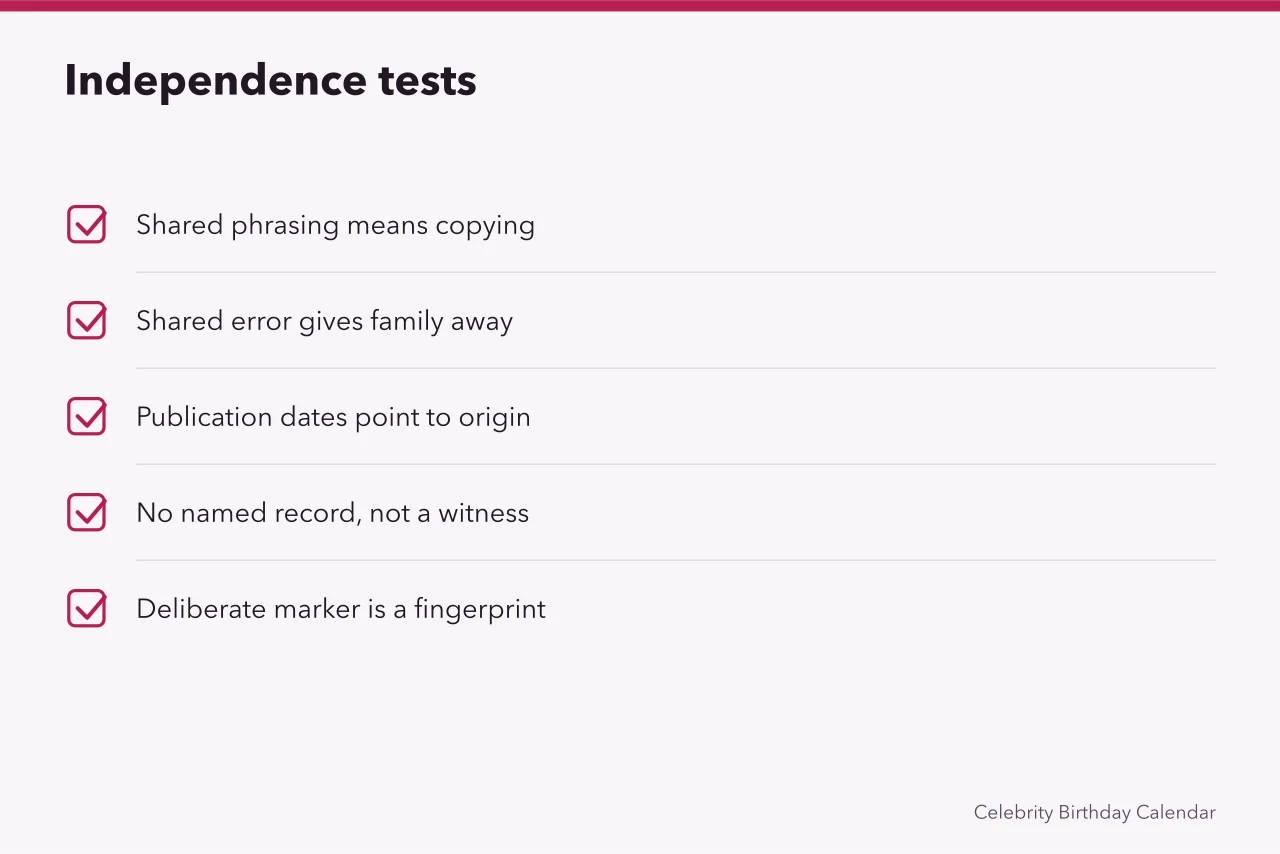
- Look for shared phrasing. Identical wording across sites means copying, not confirmation.
- Look for a shared error. A typo, an odd transliteration or a wrong middle initial travels with the copy and gives the family away.
- Check dates of publication. If everything postdates one entry, that entry is probably the origin.
- Ask what each source claims to have consulted. A source that names no record is not a witness.
- Look for a deliberate marker. Reference works have long planted a fictitious entry to detect copying, and the same logic applies in reverse: a distinctive quirk repeated everywhere is a fingerprint.
If a value fails these tests, it is one source, whatever the count of pages showing it.
What a correction has to record
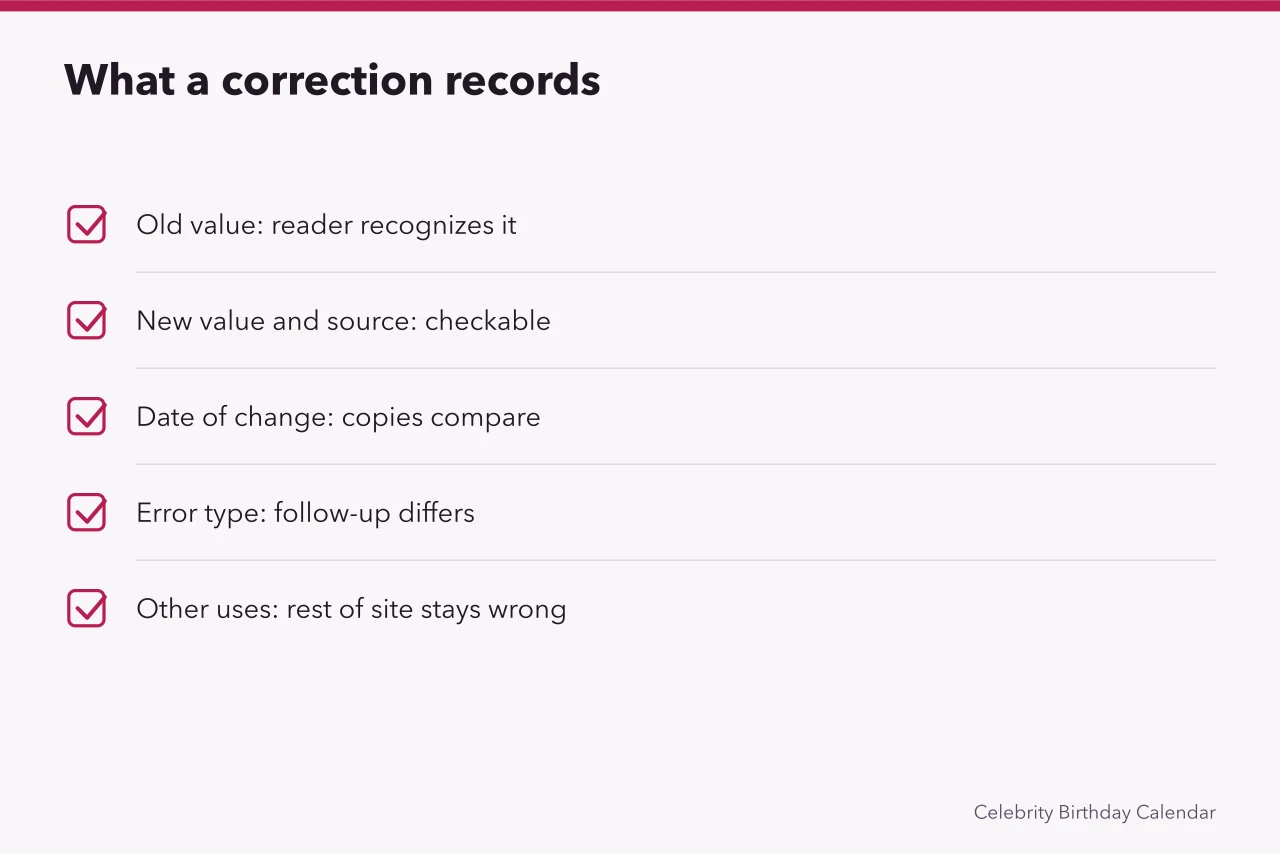
| Record | Why |
|---|---|
| The old value | So a reader who arrives holding it recognizes what happened |
| The new value and its source | So the correction can itself be checked |
| The date of the change | So other copies can tell whether they predate it |
| What the error was | A transcription slip and a fabricated entry need different follow up |
| Where else the old value was used | Corrections inside one page leave the rest of the site wrong |
A silent edit fails all five. It fixes one page and leaves everyone who copied it, or who remembers the old value, with no way to reconcile the two.
Living with it as a reader
You cannot fix the wider record, but you can stop adding to it. Repeat a date only when you can say what it rests on. If evidence is thin, write uncertainty into the sentence instead of picking the tidier version.
A page that says the date is disputed and names competing sources is more useful than one that resolves the dispute by choosing.
The profession pages carry this weight unevenly. Dates for September actors and late-year musicians mostly trace back to publicity material rather than records, which is a shorter chain but a weaker start.
The month pillar for late-year birthdays sets the scope for the period. The name list for the same months covers who gets a date published at all. The April index describes the compilation record that makes a correction possible in the first place, and the January index carries the correction route itself.
Common questions
How many independent sources are enough?
Two that genuinely trace to different records is far stronger than ten that trace to one. Count sources by their origins, not by their web addresses.
Should a page keep the old value visible after a correction?
Yes. Readers arrive carrying the old value, and a page that shows no trace of the change looks like it was always right, which teaches nobody anything.
What if the original record itself was wrong?
Then you have a documented error rather than an undocumented one, which is progress. Say what the record states and what contradicts it, and leave the disagreement standing.
: the 2027 view](/covers/famous-late-year-birthdays-640.webp?v=3c42b113)