Costs
Part of September birthdays, cross-checked against the record
3 details of famous September birthdays people miss
Three overlooked details about famous September birthdays: which day of the month clusters hardest, how a birth time shifts a date, and why sources disagree.
Three details about September birthdays get skipped on almost every list of famous September birthdays. They are the day of the month that clusters hardest, the birth time that can move a date by a full day, and the source disagreements that never get resolved. Each one is checkable against a public record.
What to take away
- September 9 is the most common US birth date, ahead of every other day of the year, and the ranking holds across decades of Social Security Administration counts. Adam Sandler and Hugh Grant were born that day.
- September 19, 12 and 10 follow close behind. Jimmy Fallon, Jennifer Hudson and Colin Firth sit in that cluster.
- A birth time recorded in a different zone than the birthplace can move a September date by a full day, and only the certified copy settles it. Prince Harry's September 15, 1984 arrival was announced as 4:20 pm.
- Where two authorities disagree on a September date, the honest entry states both and names each source rather than picking one. Calendar systems produce some of the widest gaps.
- The ecological fallacy and Simpson's paradox explain why a month-level pattern never describes an individual entry.
- Republishing a birth date has publicity-rights limits that vary by state; a licensed attorney answers those, not a calendar page.
Detail one: September 9, not the month
September 9 is the most common birth date in the United States. The Social Security Administration publishes national birth counts by day of year in its actuarial tables, and September 9 sits at the top, with September 19, September 12 and September 10 close behind.
The clustering belongs to September alone. No other month puts that many days near the top of the same table.
The named birthdays match the pattern. Adam Sandler (1966) and Hugh Grant (1960) were born on September 9. Jimmy Fallon arrived on September 19, 1974; Jennifer Hudson and Paul Walker share September 12; Colin Firth was born on September 10, 1960.
The mechanism behind the cluster is arithmetic. A September 9 birth points back to a conception window around mid-December, and US hospital delivery schedules, holiday staffing and elective induction patterns push deliveries toward that window.
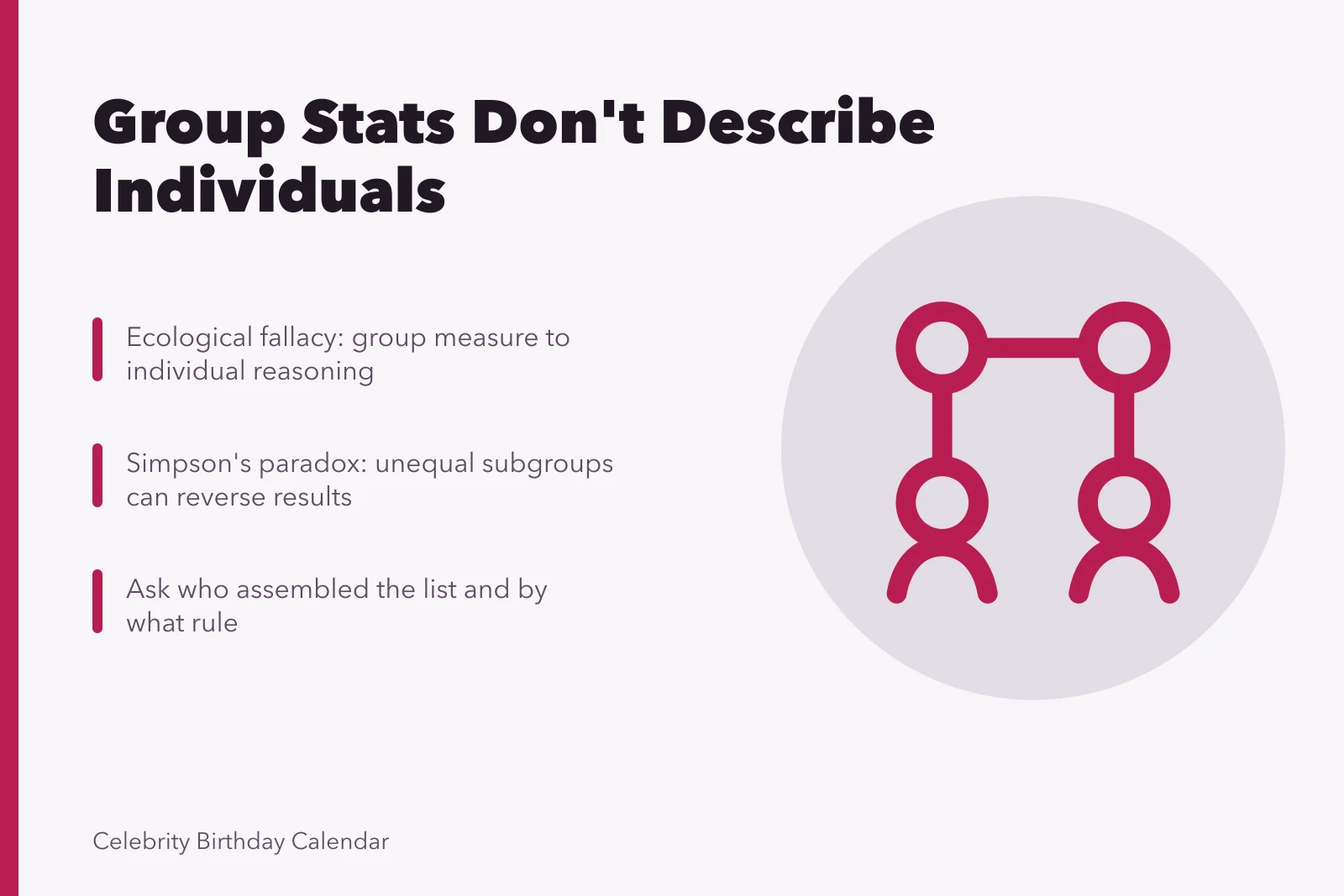
That distinction is the ecological fallacy: a group-level measure does not transfer to an individual.
A page listing famous September birthdays shows a collection assembled under a rule. Any regularity a reader spots belongs to the collection, not to the people in it.
Detail two: the birth time moves the date
A birth certificate records a time as well as a date, and the time is local to the birthplace. When a date is transcribed from a hospital record into a league media guide or a studio publicity file, the time can be dropped.
Drop it, and a birth late on September 30 in a time zone ahead of the recording office can land on October 1 in the copied record. Truman Capote (1924), Monica Bellucci (1964) and Martina Hingis (1980) all sit on that September 30 edge.
Julie Andrews (October 1, 1935), Jimmy Carter (October 1, 1924) and Brie Larson (October 1, 1989) sit on the other side, where a misread clock turns an October date into a September one.
Where a birth time is announced in public, the date can be checked back to the hour. Buckingham Palace announced Prince Harry's arrival on September 15, 1984 at 4:20 pm at St Mary's Hospital in London.
The fix is not to guess. Ask the issuing vital records office for the certified copy, and check the time zone of the birthplace against the zone of whoever recorded the date.
The US National Center for Health Statistics publishes the standard certificate format. The state or provincial vital records office holds the actual entry and its eligibility rules for release, and a birth abroad carries a consular report of birth abroad instead.
This is also where identifiers earn their keep. Full name, middle initial and birthplace separate two people who share a September date.
Detail three: sources disagree, and that is the entry
Take any famous September birthday and check three sources: the state vital records office, the subject's own published statement, and a reference work. They will sometimes disagree by a day, a year, or by the calendar the entry was first written in.
Calendar systems produce the widest splits. Queen Elizabeth I was born on September 7, 1533 under the Julian calendar England used at the time. The same moment reads September 17, 1533 in the Gregorian calendar, and both dates appear in print.
Russia kept the Julian calendar until 1918, so Soviet-era sources dated Ivan Pavlov's birth September 14, 1849, while later references give September 26, 1849. Leo Tolstoy's September 9, 1828 birthday appears as August 28, 1828 in Old Style records.
The disagreement is the fact worth publishing. State both dates, name each source, and let the reader weigh them. Resolving the conflict by picking the more authoritative-looking source is how a wrong date becomes permanent. The September birthdays by day index carries a stated source for each entry for exactly this reason.
| The setup | The consequence |
|---|---|
| Subgroups of unequal size combined | The larger subgroup dominates the total |
| A factor that differs across subgroups | It can drive the aggregate on its own |
| Aggregation done without stating the split | The reversal is invisible |
| A conclusion drawn from the total | It may contradict every part |
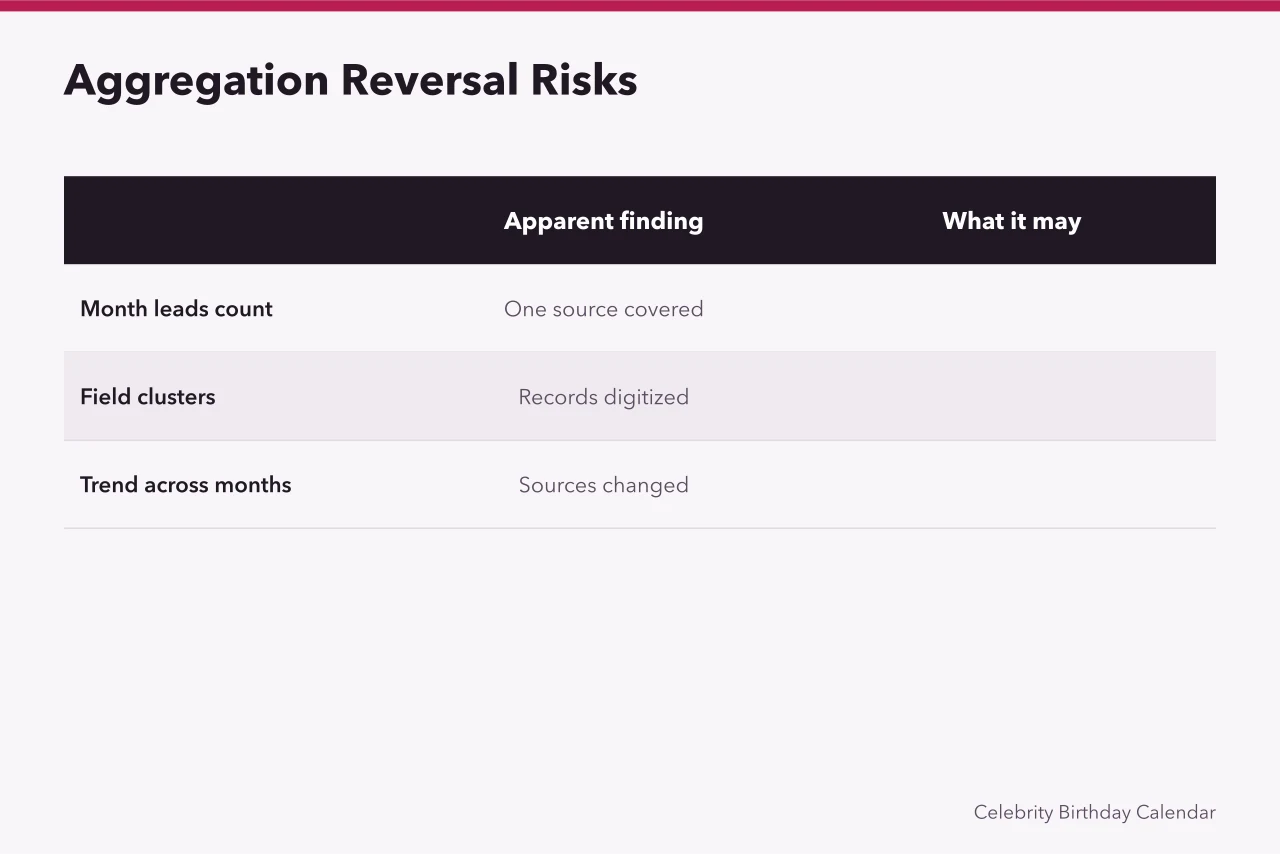
The reversal is Simpson's paradox, and it is why a month-level count of famous September birthdays can point one way while every source subgroup points the other.
The subgroups here are the sources, the fields and the eras, and they are never the same size.
| The apparent finding | What it may actually be |
|---|---|
| One September day leads the count | One source covered that period more thoroughly |
| A field clusters in early September | That field's records were digitized differently |
| A trend across the month | A change in what the sources covered |
What follows for reading a list
- Ask who assembled the list and by what rule before asking what it shows. The January famous page sets out the documentation threshold this site uses.
- Never carry a group observation to a person.
- Where a total is offered, ask what was combined to make it and whether the parts agree.
- Remember that the calendar bucket is a slice of a continuum, not a category with members who share anything. The September index treats it that way, and the January index explains the inclusion rule that decides who is in the slice at all.
Common questions
Is it ever safe to reason from a group to a person?
Only as a probability, stated as one, when the group really is the person's reference class and the measure really applies. On a page of this kind none of those conditions holds, so the answer in practice is no.
Does a larger list fix this?
No. The error is in the direction of the inference, not in the sample size. A bigger list gives a more precise group-level number and licenses exactly the same amount of individual-level reasoning, which is none.
Why do these inferences feel so natural?
Because a list of names is a list of people, and the reader's attention moves to the people while the statistic is about the collection.
What can a month page legitimately say?
That it holds these entries, assembled under a stated rule, from stated kinds of source. That is a claim about the page, which is the only thing the page is in a position to know.