
Rules
Part of September birthdays, cross-checked against the record
A closer look at athletes with September birthdays
Athletes with September birthdays: age at an event against age today, what selection cutoffs do to a month, and what proving an age actually rests on.
Sport is the field where a birth date does the most work. It decides which squad a child joins, which category an adult competes in, and whether a record counts. It is also where the word age is used for two different things in the same sentence, which is where most of the confusion starts.
What to take away
- Age at the time of an event and age today are different numbers, and only one of them belongs next to a result.
- Selection cutoffs turn a birth date into an advantage or a disadvantage that has nothing to do with ability.
- A recorded age is only as good as the document behind it, and in sport the documents vary enormously in quality.
Two questions that share one word
Ask how old an athlete is and you get today's number, which changes every year and is out of date the moment it is written. Ask how old they were when something happened and you get a fixed number that never changes again. Reference pages mix them constantly.
The mixing produces a specific class of error. A line written as youngest to do X was true on the day it was published and silently stops being true. Worse, a later editor recomputes it against the current date and produces a number that is arithmetically correct and historically meaningless.
The fix is dull and effective. The January athletes page covers the three ages that get confused.
Store the birth date and the event date, never the difference. Compute the age when you display it, and label which question you answered. A page that stores an age instead of a date is guaranteed to be wrong eventually, and will look confident while it happens.
Cutoffs and the pattern they create
Youth sport groups children by a cutoff date. Everyone born in the qualifying window plays together. The oldest and youngest in a group can be nearly a year apart, and at that age a year is a large fraction of a life.
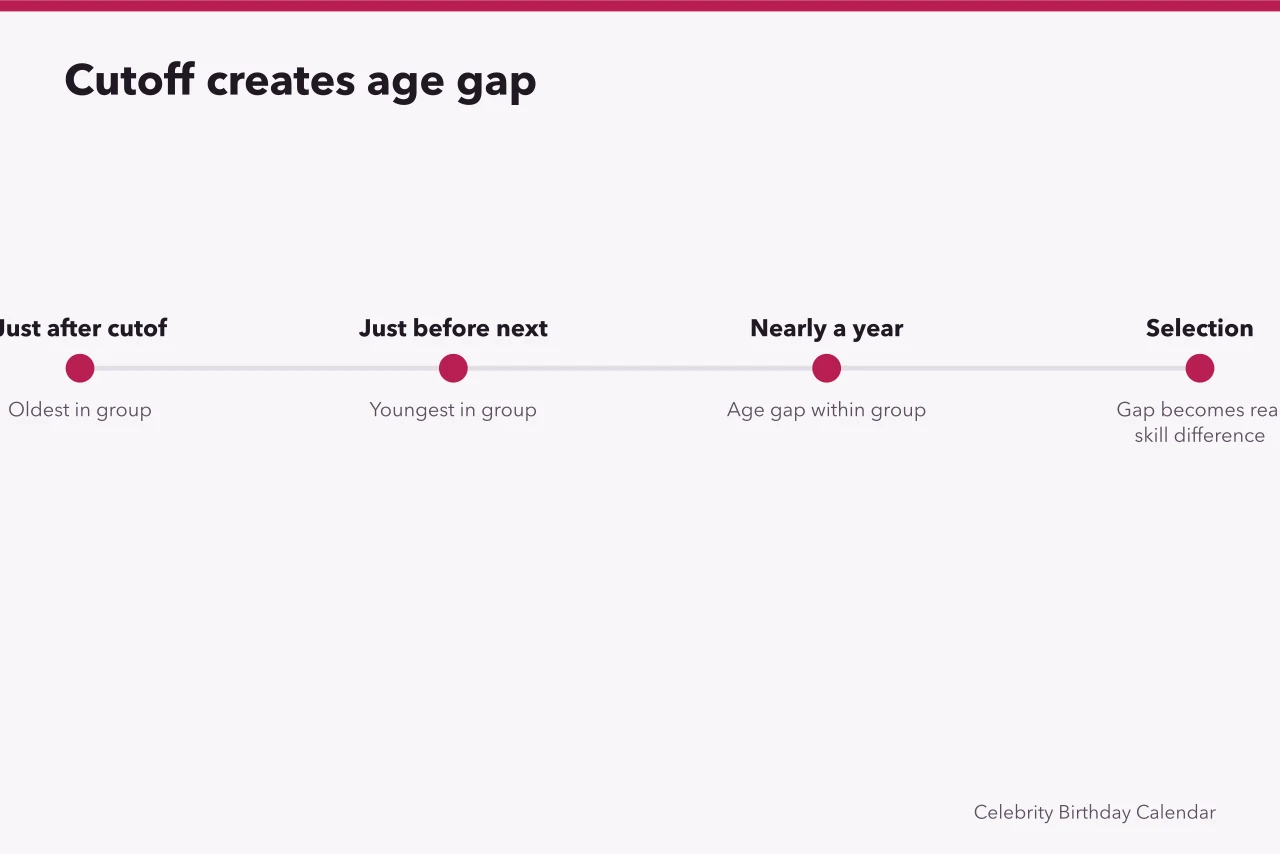
Children born just after the cutoff are the oldest in their group. They are bigger, faster and further developed than the children born just before the next one.
Coaches select. Selected children get more coaching, better competition and more encouragement, and the initial gap becomes a real difference in skill. Researchers call this the relative age effect, and it is one of the few cases where a birth month genuinely has a mechanism behind it rather than folklore.
Two things follow for anyone reading a list. First, if a professional roster shows a clustering by month, the cutoff used in that sport and country is the thing to look at before anything else. Second, the effect belongs to the selection system rather than the athletes, so it says nothing about any individual on the list.
Proving an age
Eligibility requires a check against an identity document, and the check's strength depends entirely on the registration system behind the document.
Where civil registration is universal and old, the document is strong. Where registration came late, was interrupted, or was reconstructed from memory, it records what someone reported.
That is why age disputes in sport are rarely about lying and usually about records. Two documents disagree, both were issued in good faith, and the governing body has to decide which system it trusts. A calendar page cannot resolve that and should not pretend to. It can note that a date is disputed and say who disputes it.
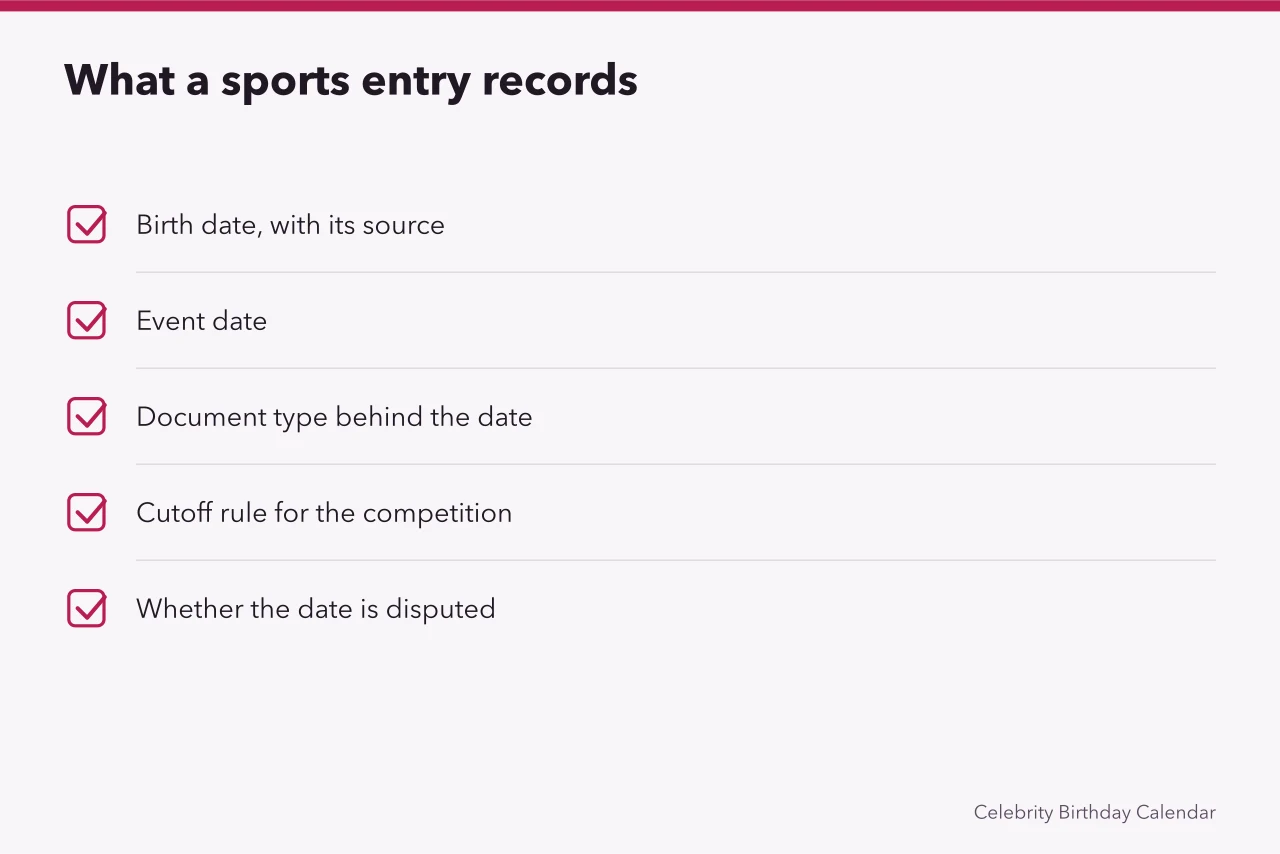
What a sports entry should record
| Field | Instead of |
|---|---|
| Birth date, with its source | An age with no date behind it |
| Event date | A relative phrase like last season |
| The document type behind the date | An unattributed number |
| The cutoff rule for the competition | An assumption that cutoffs are the same everywhere |
| Whether the date is disputed | A single value chosen for tidiness |
None of those fields requires publishing a date, and this site publishes none. The January index sets out the inclusion rule and the route for a correction.
Where to look next
The month pillar for September birthdays covers the entire month, not one profession. For the same treatment in other months, see June athletes, August athletes and March athletes, which draw on the same registration systems.
A mixed list such as September's better known figures blends athletes with professions where no governing body ever checks a document. The difference in evidence quality is invisible once the names sit in one column.
Common questions
Does a September birthday help or hurt an athlete?
It depends entirely on the cutoff date for their sport, country and era, and cutoffs differ. The month on its own tells you nothing until you know the rule it was measured against.
Why do age disputes surface late in a career?
Because the checking gets stricter as the stakes rise. A document that was never questioned at club level gets examined when international eligibility depends on it.
Should a list state ages at all?
It can, if it states the date the age was calculated for. An age with no reference date is a number with a hidden expiry on it.


: the 2027 view](/covers/famous-late-year-birthdays-640.webp?v=3c42b113)